Miro is the AI innovation workspace, helping 100M+ users and 250,000 customers plan, design, and build together.
Miro spent nearly two years building its creator program with agencies. But as it tried to scale, finding the right creators took time, and the team often had to handle outreach itself. Reporting was spread across Airtable, Google Sheets, and other tools, making it hard to see the full picture.
Passionfroot gave Miro one place to find creators, manage campaigns, and track performance. Its AI agent, Zest, helps the team source creators and get insights in front of leadership faster. With a more streamlined approach, Miro consistently moves from brief to live creator content in just two weeks.







The collaboration platform brought its creator program into one place, put AI to work, and built a faster way to turn product launches into live creator content
As Miro grew its AI capabilities and reimagined how teams build and collaborate, its creator marketing team set out to reach an even wider audience of engineers, product experts, and designers—and fast.
We spoke with Aida Ahmed, who leads creator marketing and social media at Miro, about how they achieved speed and scale, plus their holistic strategy for working with creators.
The challenge: Scaling a creator program that had outgrown its agency model
By the time Miro came to Passionfroot, the team had spent nearly two years building its creator program. They’d worked with agencies, tested different approaches, and had solid wins under their belt. But, the model started to break as Miro tried to scale.
Finding and reaching the right creators was slow. In some cases, even with an agency partner, Miro's own team still had to step in and handle outreach. That meant more work on both sides, delays, and campaign timelines that were harder to manage.
Reporting was another big sticking point. Information lived across Airtable, Google Sheets, and other tools, making it difficult to get a complete picture of who Miro was working with, what content was going live, and what the team was learning.
Plus, Miro wanted to move beyond one-off campaigns toward a steady stream of creator content, with the ability to move fast as new product features launched. Miro needed an AI-native partner that could help the team move faster, bring its workflows together, and make better use of its creator data.
The solution: Bringing creator marketing into one place
Passionfroot gave Miro a centralized place to manage its creator program, from finding and activating creators to organizing campaigns and understanding what's working. Instead of information and activity being scattered across different tools and teams, the work could build on itself.
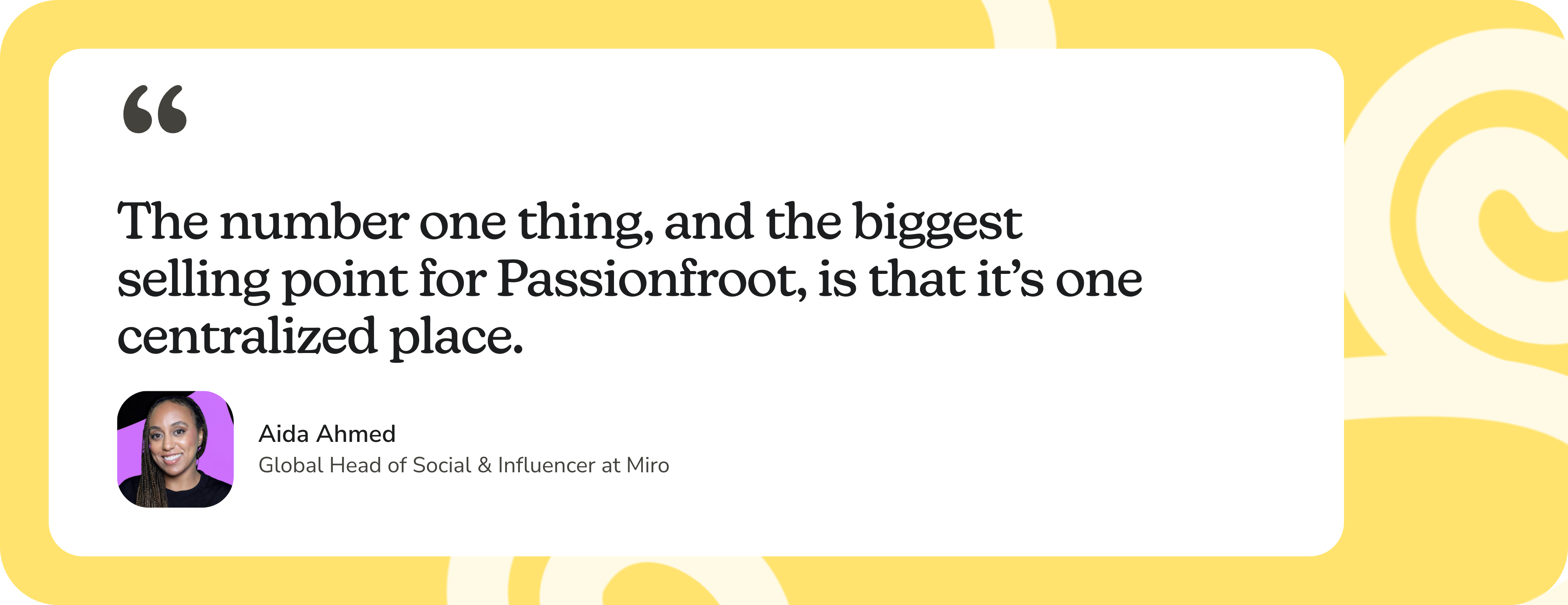
For Aida, that shift has made a difference in three key areas.
1. Finding the right creators and getting content live faster
Miro wanted to grow its creator community, particularly among the engineering, product, and design audiences it was trying to reach. But finding the right voices, and getting from initial outreach to published content, had become a bottleneck.
Within its first two months on Passionfroot, Miro compared its activation speed with its previous process and found it was moving 3.6x faster.
With product launches right and left, often with little lead time, they now feel confident that creator content can keep pace. And instead of starting from scratch each time, the team easily builds on existing playbooks and wins.
2. Putting AI to work on reporting and insights
Miro came to Passionfroot looking for an AI-native platform that could help the team move faster. With creator research, campaign information, and reporting in one place, the team can build on shared learnings instead of piecing together information across tools.
Zest, Passionfroot's native AI agent, also helps Miro make better use of its creator program data, particularly when it comes to insights and analysis. For example, Miro now has a dedicated Slack channel for its creator program with senior leaders. The team shares weekly updates on what's going live, who they’re working with, plus key metrics and trends.
Previously, pulling that picture together took considerable time. Now, the team can get data in front of leadership more quickly, and work with Zest to plan what should come next.
3. Turning product launches into creator campaigns faster
Rather than building every campaign from scratch, Miro runs an always-on program for its AI features, alongside larger product launches and events.
A good example is its AI always-on brief: a living document that brings Miro's AI features together in one place. Creators can choose the product or angle that best fits their audience, while the team can update the brief as new features roll out.
The approach proved particularly valuable for Miro's recent Mermaid Diagramming launch, a tool aimed at engineers. Finding creators who could speak credibly about the technical product meant looking beyond Miro's usual channels and sourcing skilled engineering voices on X. Zest helped the team source and vet those creators, making it easier to find people who could bring the product to life for the right audience.
Miro was able to adapt its existing brief, find creators with the right technical audience, and get content out within two to three weeks. The resulting content included posts from DataChaz and Svpino.
The team has also used Passionfroot to expand how it works with creators. For the first time, Miro sent a creator to ProductCon to cover the event on the brand's behalf. It was Miro's first time extending the partnership beyond a sponsored post into event coverage, user-generated content, and a takeover of Miro's social channels.
Miro's always-on campaigns also give creators room to choose the features and angles that best fit their audiences. Examples include Instagram content with Viktoria Semaan and LinkedIn content with Matt Przegietka and Colin Duff.
The results: Faster activation and a clearer view of what's working
For Miro, the clearest early result was 3.6x faster creator activation within the first two months on Passionfroot.
Its creator community has also grown by 75% since it started working with Passionfroot, giving Miro a wider network of voices to draw on as its product and creator strategy evolve.
What’s more, in roughly six months, Miro has generated nearly 4.5M impressions through a more strategic, always-on approach to creator marketing, rather than relying on one-off campaigns with agencies.
But the team is also looking beyond impressions alone. Miro tracks reach and engagement, paying particular attention to the quality of comments on LinkedIn, where much of its decision-maker audience is active.
Those conversations offer clues about how people perceive the brand, which product use cases resonate, and whether Miro is starting to be seen as more than a digital whiteboard.
The team combines those signals with its broader brand and social listening, looking at how Miro's share of voice compares with competitors and which topics are gaining traction. It then uses those insights to adjust briefs and messaging week over week.
As Aida puts it, the goal isn't just to report on what happened, but to understand what's working and use that to make the next campaign better.
Aida's advice for brands getting started with creators
Aida's advice is simple: start, experiment, and find what works for your brand.
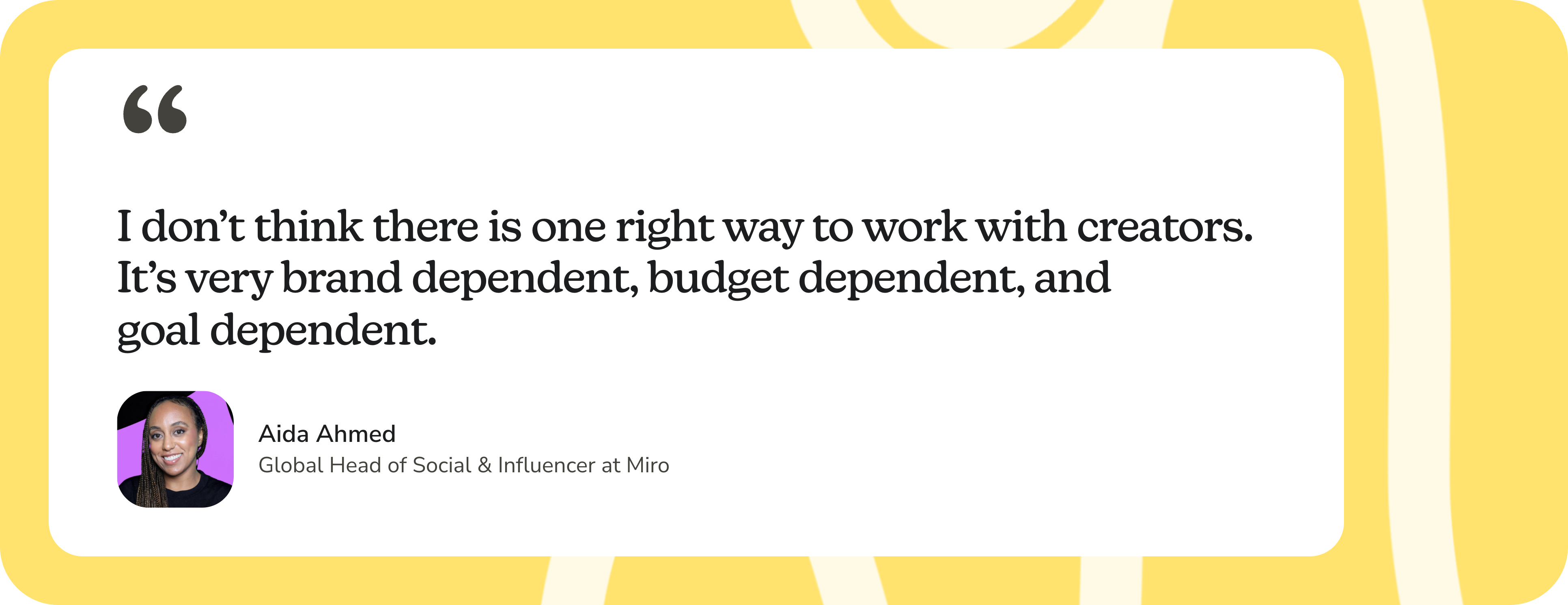
She also encourages brands not to overlook smaller or emerging creators. Miro has seen the value of working with voices early, developing real relationships, then growing those partnerships as their audiences expand.
With Passionfroot, Miro can spend less time coordinating its creator program and more time finding the right voices, learning from what works, and turning new product launches into compelling creator content.